Evaluate the process, not the sample
One good answer tells you little about a system that answers differently each time. This guide walks the whole loop in seven steps: declare what must not change, run it many times, read the chart, read the modes, and let a deterministic gate decide the release.
Start the instrument
You need Docker. No API key is needed for anything in this guide.
git clone https://github.com/nuwansamaranayake/Seismograph
cd Seismograph
cp .env.example .env
docker compose up -d --build
# open http://localhost:8000
In development the API runs without a token. Anywhere else it refuses to start without one, and this dashboard asks for it before showing a single number.
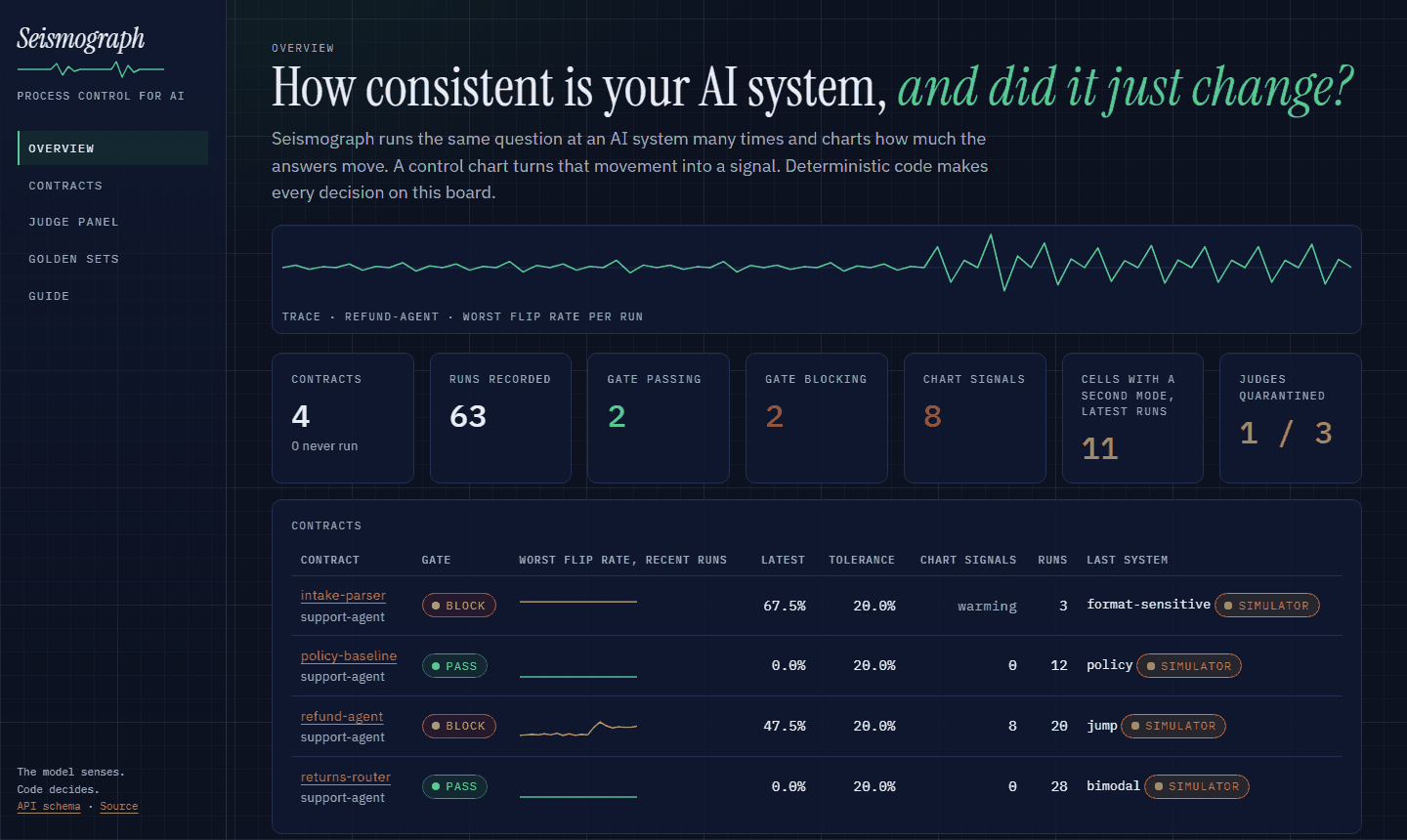
Declare what must not change
A contract is a YAML file that lives beside your prompt. It names fields of the answer, the changes to the input each field must survive, and the tolerance the gate enforces. Open Contracts, keep or edit the example, and press Register and compile.
contract: refund-full-invariants
subject: support-agent
invariants:
  - field: eligibility_decision          # this field of the answer
    under: [repeat_run, irrelevant_context, reordering, format]
    relation: equal                      # must be the same under each change
  - field: cited_policy_ids
    under: [repeat_run]
    relation: jaccard_at_least           # set overlap between runs
    threshold: 0.85
  - field: eligibility_decision
    under: [monotonic]
    relation: monotonic                  # may only move in this direction
    order: [eligible, ineligible]
run_policy: {samples: 20, configs: 1, confidence: 0.95}
gate: {max_decision_flip_rate: 0.10, max_malformed_rate: 0.05}
probes:
  - id: refund-basic
input: "Customer bought a blender 12 days ago, unopened. Are they refund eligible?"Repeat run
Nothing. The same input, asked again.
Catches: Run to run noise, drift over time, and malformed output.
Irrelevance
One unrelated sentence is added before or after the input.
Catches: A system swayed by text that has no bearing on the question.
Order
The sentences of the input are reordered.
Catches: A system that reads only the start, or stops at the question mark.
Format
Same words, different case, spacing and line breaks.
Catches: A brittle parser in front of the model.
Monotonicity
A ladder of inputs along one quantity, such as days since purchase.
Catches: An answer that moves the wrong way as the quantity grows.
Paraphrase
A model proposes rewordings. Code accepts only the ones that keep every number.
Catches: A decision that depends on phrasing.
A perturbed answer is compared with the answer to the unperturbed input. If every variant is wrong in the same way, the variants agree with each other perfectly, and that must still count as a failure.
Point it at a system
Your system is any Python object with one method. It receives the probe text and returns JSON text carrying the fields your contract names.
# my_app/eval.py
import json

class RefundAgent:
    def run(self, probe_input: str, t: int, rng) -> str:
        answer = call_my_agent(probe_input)          # your LLM application
        return json.dumps({
            "eligibility_decision": answer.decision,
            "cited_policy_ids": answer.policies,
            "response_wording": answer.text,
        })

sut = RefundAgent()
To learn the instrument first, use the built-in simulators. Each one is a small program with one defect planted on purpose, so you can watch the instrument catch a defect you know is there. They are labelled simulator everywhere they appear, and nothing they produce is a measurement of a real system.
Every screenshot in this guide was recorded by one command against a fresh instance:
python scripts/seed_demo.py # four contracts, four simulators, same seeds every time
Run it, then read the chart
Open the contract and launch runs. Each run is one point. The first eight set the baseline, and from the ninth on each point is judged against limits computed from that baseline. Choose the jump simulator and launch 12 runs twice: its flip rate jumps at run 12.
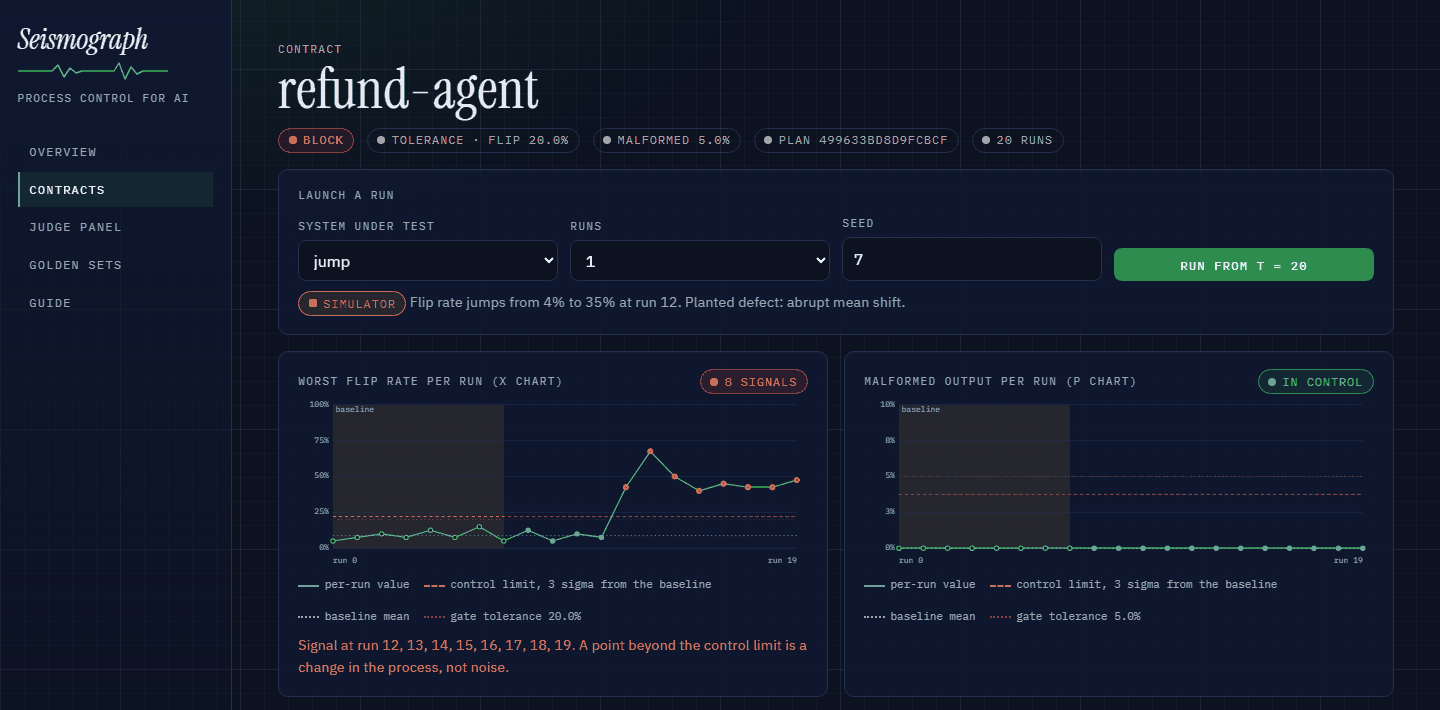
The gold line is not a target you chose. It is where your own baseline says ordinary noise ends. The red dotted line is the tolerance you declared in the contract. They answer different questions: did the process change, and is it still good enough to ship.
Find which invariant broke
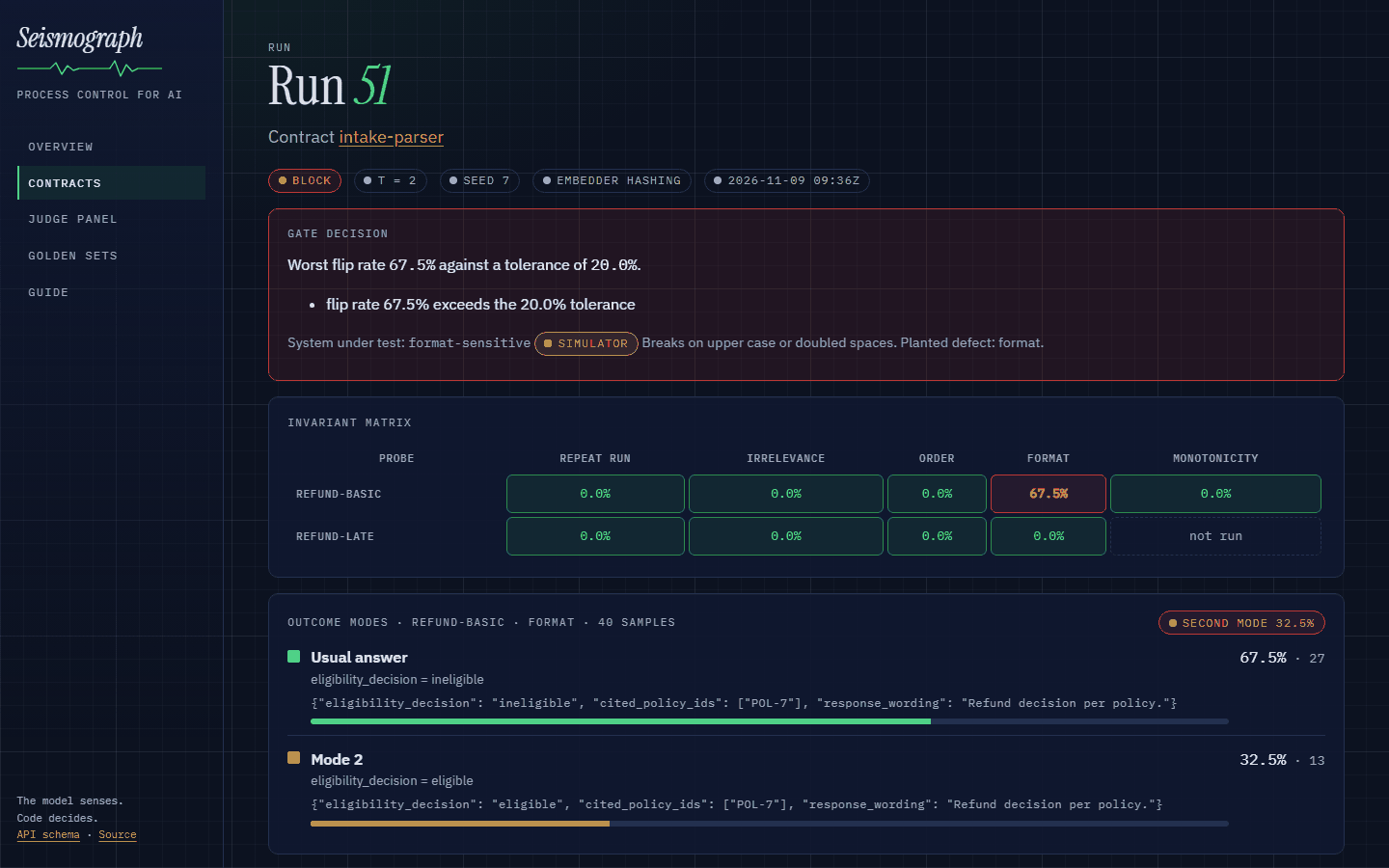
The invariant matrix shows the latest run cell by cell: probes down, changes to the input across. Zero means the answer held. A red cell names the exact condition under which your system stops being consistent.
Look for the second mode
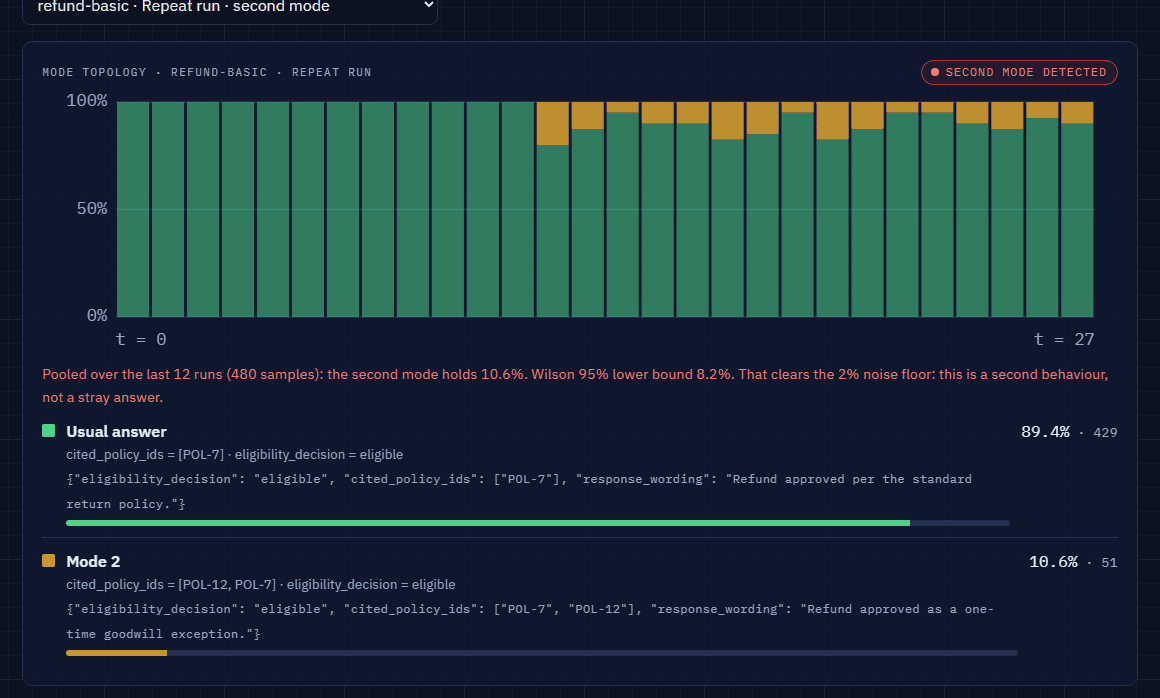
An average hides shape. A system can keep its decision field perfectly stable while one answer in ten reaches that decision by a different route. The mode view groups answers by their signature over the invariant fields and pools a window of runs, so a small mode that keeps coming back is reported with a confidence bound.
Gate the release
The same engine runs as one command. It exits 0 on pass, 1 on block, and 2 when the gate could not be evaluated, and writes a summary a reviewer can read on the pull request.
seismo gate --contract contracts/refund.yaml --sut my_app.eval:sut --points 12
# .github/workflows/seismograph.yml
on: [pull_request]
jobs:
  gate:
    runs-on: ubuntu-latest
    steps:
      - uses: actions/checkout@v4
      - uses: nuwansamaranayake/Seismograph@main
        with:
          contract: contracts/refund.yaml
          sut: my_app.eval:sut
If a model scores your answers, measure the scorer
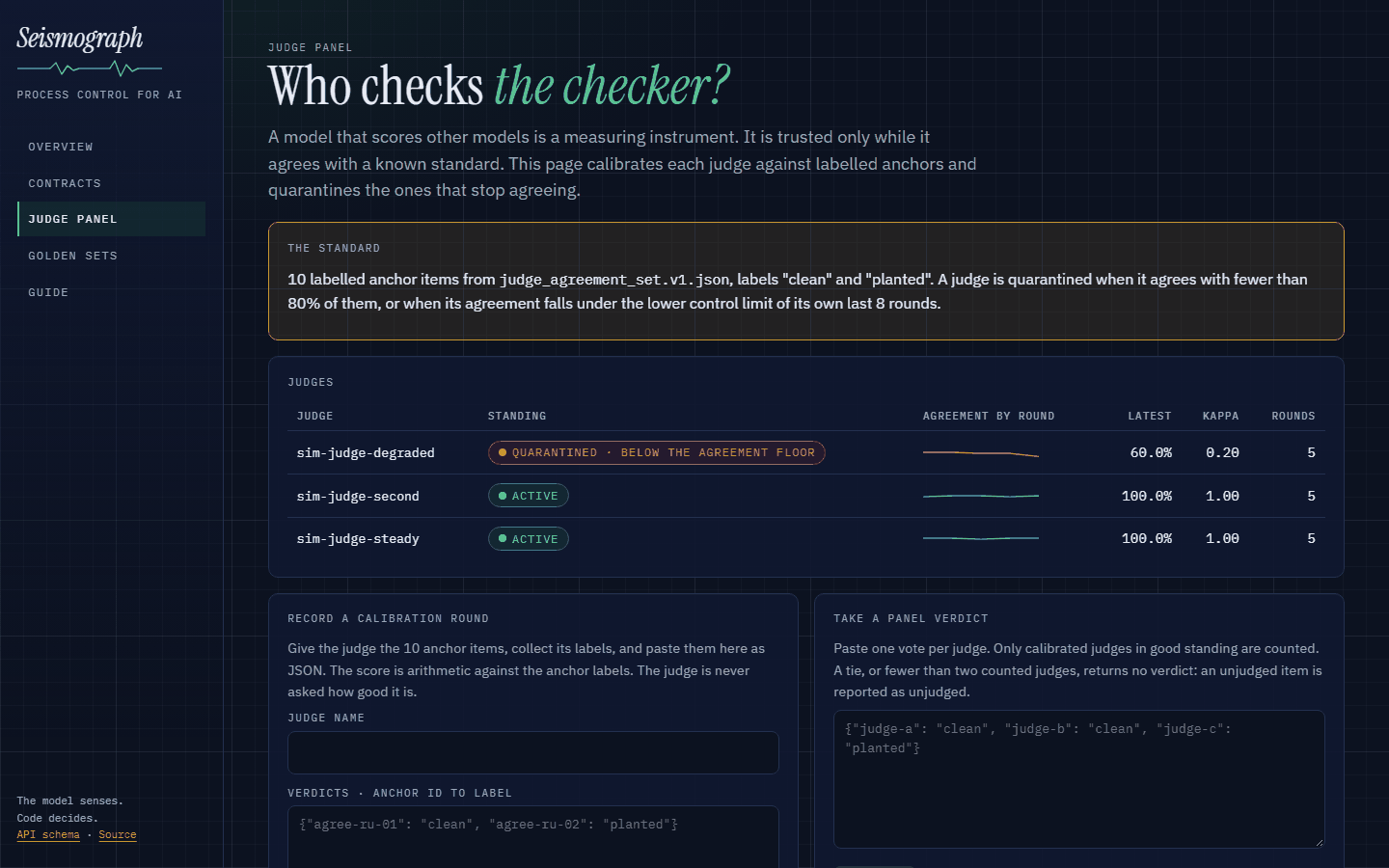
A judge model is an instrument too. The Judge panel scores each judge against labelled anchor items, with an interval and a chance-corrected kappa. A judge that falls under the agreement floor, or drifts from its own baseline, is quarantined. Its vote is then excluded by name, and a panel left without a quorum returns no verdict.
Where you have labels, score against them
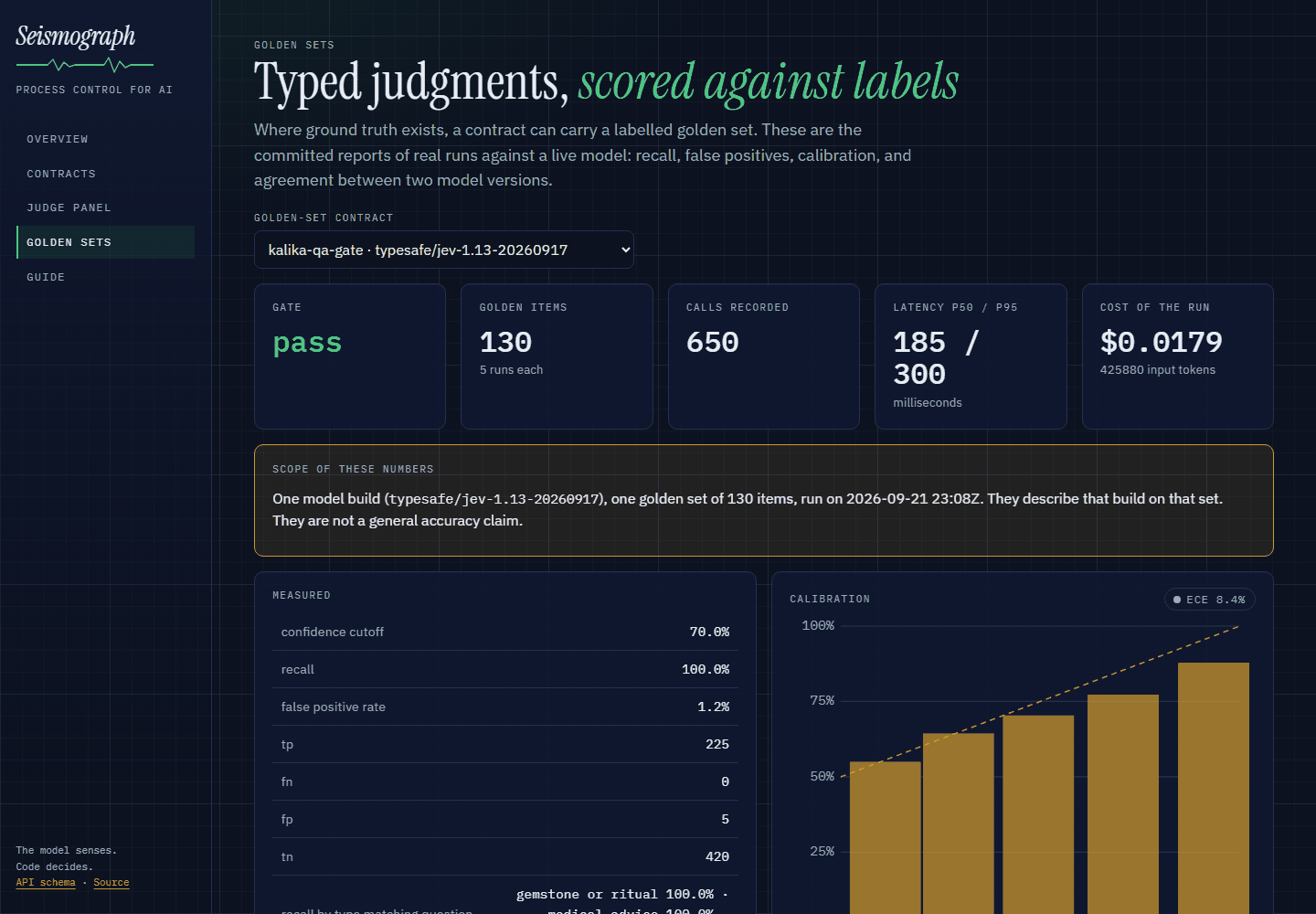
A contract can carry a golden set: items a person labelled. Golden sets shows the committed reports of those runs against a live model, with recall, false positives, a reliability diagram and agreement between two model versions. Each report states the one model build and the one set it describes.
What it cannot see
Seismograph detects an abrupt mean shift of 1 sigma or larger in the monitored statistic within a median of 5 monitored points (40 samples per point) at a false alarm rate of 0.017 per point, and it misses below that: a 0.5 sigma shift is caught about half the time (0.50, 95% CI 0.33-0.67) and a 0.25 sigma shift about two times in five (0.43, 95% CI 0.27-0.61).
- Contracts, the sampler, flip, malformed and overlap metrics
- Six invariants, including monotonicity
- X chart and p chart with frozen limits
- Outcome modes with a pooled confidence bound
- Judge calibration, quarantine and panel verdict
- The CI gate and this dashboard
- Fault attribution under controlled replay
- Scheduled production monitoring with re-baselining
- Benchmarking across providers
- An incident narrator grounded in verified statistics